Why Colocation Redundancy Is the Line Between Normal Operations and Business Disaster
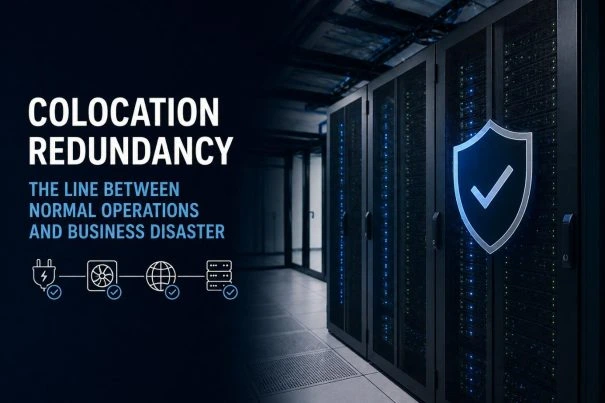
When power, cooling, or connectivity fails in a data center, the cost meter starts ticking before an administrator even has time to pick up the phone. Colocation redundancy answers the question every CTO asks long before the first incident occurs: What happens when the components that must not fail actually do? In this article, we break down the individual layers of protection, explain the difference between Tier 3 and Tier 4, and show when investing in full fault tolerance truly pays off.
Behind every available digital service stands infrastructure that will eventually fail; the only question is whether anyone will notice. Colocation redundancy is the architectural answer to this problem: not the prevention of failure, but the elimination of its impact on operations. In the following sections, we will examine how it works layer by layer.
What Is Colocation Redundancy and What It Consists Of
Colocation redundancy refers to a state in which a data center operates backup components for every critical part of the infrastructure, ensuring that the failure of a single component does not compromise overall operations. It is not just about data backup but about physically separated and parallel systems for power, cooling, connectivity, and networking.
At its core, it is built on four layers:
- power – backup UPS units and diesel generators take over during grid outages,
- cooling – redundant cooling systems prevent thermal failure of the server environment,
- connectivity – fiber routes from independent providers eliminate reliance on a single connection,
- network infrastructure – duplicated switches and routers remove single points of failure at the data flow level.
Each layer operates independently, but together they form an infrastructure capable of withstanding scenarios that cannot be fully anticipated in advance.
Three Failure Scenarios Where Colocation Redundancy Makes the Difference
Power outages, overheating server rooms, and disrupted fiber routes are three situations often described as edge cases in technical documentation, yet they have occurred even in otherwise well-managed infrastructures.
Power Outage
According to the Uptime Institute’s Annual Outage Analysis 2025, power issues account for 45% of all major incidents. When the main grid fails, UPS systems respond instantly and seamlessly, bridging the gap until diesel generators reach full output, typically within 10 seconds. An N+1 configuration ensures one additional backup source beyond operational capacity, while a 2N configuration runs two fully independent power circuits in parallel, meaning the failure of one does not cause even a moment of disruption.
Cooling Failure
A server room without functional cooling can reach dangerous operating temperatures within minutes. Hardware protection mechanisms will respond, but not in a way you would want. Redundant cooling units in an N+1 configuration take over the load without delay, while a 2N configuration operates two parallel and fully independent systems, each capable of handling full capacity. The failure of one unit does not stop operations.
Connectivity Disruption
Construction work nearby, a network failure at the provider level, or physical damage to a route—connectivity disruptions do not have to be related to the condition of the data center itself. Secure colocation therefore includes fiber connections from multiple independent providers, routed through physically separate paths. If one connection fails, the other automatically takes over without impacting operations.
Read also: How Much Does Therapy Cost? A Complete Breakdown for 2026
Tier I to IV: How Data Center Redundancy Levels Impact Your SLA
The Uptime Institute classifies data centers into four tiers, each defining a minimum standard of data center redundancy, which directly determines the SLA a provider can guarantee. The overview below highlights the key differences:
| Tier | Redundancy | Availability | Max. Downtime/Year | Typical Use Case |
| I | None | 99.671% | ~28.8 hours | Testing environments |
| II | N+1 (partial) | 99.741% | ~22 hours | Small businesses |
| III | N+1 | 99.982% | ~1.6 hours | Enterprise IT, e-commerce |
| IV | 2N (fault tolerance) | 99.995% | ~26 minutes | Finance, healthcare |
Tier III and IV are the most relevant for enterprise operations. The key difference between them is that Tier III allows for a temporary increase in risk during planned maintenance, while Tier IV guarantees full fault tolerance under all operating conditions.
How to Choose the Right Level of Colocation Redundancy for Your Business
Tier IV is not for everyone, and that is not a weakness but economic rationality. Its construction is 60 to 100 percent more expensive than a comparable Tier III facility because it operates two complete infrastructures in parallel.
Two key questions help guide the decision:
- What is the cost of one hour of downtime for your business? and
- What contractual obligations do you have toward your customers?
According to the Uptime Institute’s Annual Outage Analysis 2025, one in five major outages costs over one million dollars, and power issues remain the cause of 45 percent of all incidents. For most enterprise operations and SaaS applications, data center colocation at the Tier III level represents the optimal balance between protection and cost. Tier IV is typically justified where even 26 minutes of annual downtime is unacceptable, such as in finance, healthcare, or critical government infrastructure.
Sources:
- TTC TELEPORT – https://ttc-teleport.cz/en/
- Uptime Institute – Annual Outage Analysis 2025
- Wikipedia – https://en.wikipedia.org/wiki/Data_center_tiers