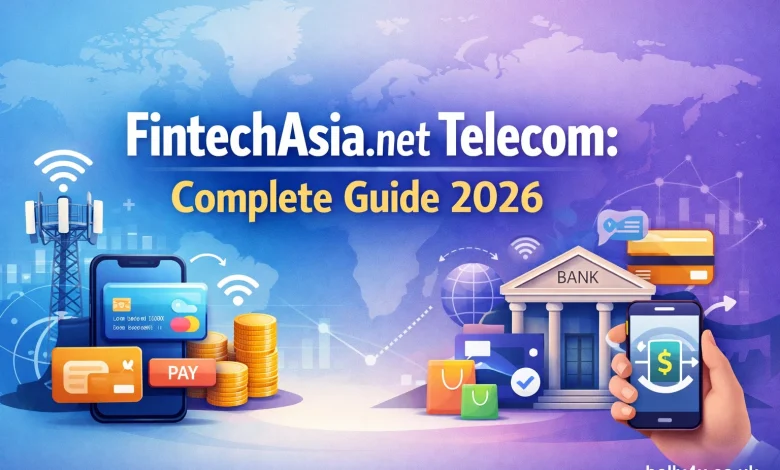
FintechAsia.net Telecom: Complete Guide 2026
Trying to figure out what FintechAsia.net Telecom means can feel a bit like opening five browser tabs and finding six different explanations.
That is because the phrase does not appear to be a widely standardized industry term on its own. Based on the pages currently available, FintechAsia.net is a content site that publishes broad business, finance, and technology articles, and one of its posts uses “FintechAsia Telekom” to describe the overlap between telecom infrastructure and digital financial services. The site’s homepage and contact pages also suggest it operates more like a publishing platform than a clearly documented telecom-fintech operator or licensed financial institution.
So this guide takes the practical route. Instead of pretending the term has a single official definition, it explains what FintechAsia.net Telecom appears to refer to, why telecom-fintech convergence matters across Asia, how real-world telecom-led finance models work, and what readers, businesses, and users should evaluate in 2026. That matters because the broader trend is very real: the World Bank’s Global Findex 2025 ties mobile access directly to financial inclusion, while GSMA says mobile money processed more than $2 trillion in 2025.
In plain English: your phone is no longer just a phone. In many Asian markets, it is becoming the bank branch, payment terminal, ID checkpoint, and customer support desk all in one. And yes, that is impressive. It is also where things get messy, because convenience and risk usually travel as a pair.
What Is FintechAsia.net Telecom?
Based on the currently accessible article on FintechAsia.net, “FintechAsia Telekom” is presented as a model that blends digital banking, payment processing, and telecommunications integration so users can access financial services through mobile networks and connected devices. The article specifically frames telecom integration as a way to connect mobile networks with banking functions and improve access, especially in remote areas.
That description is important, but it also needs context.
From what is publicly visible today, FintechAsia.net itself appears to be a publishing website, not a clearly documented telecom company, regulated bank, or named fintech platform with an obvious licensing profile on the pages surfaced here. Its homepage is organized like a general content portal, and its contact page lists a New York address and general email rather than product, regulatory, or operator disclosures that you would usually expect from a major telecom-finance provider.
So the safest, most factual interpretation is this:
FintechAsia.net Telecom appears to be a content label or editorial concept about telecom-powered financial services in Asia, rather than a clearly verified standalone platform brand.
That does not make the topic useless. Far from it. It actually opens the door to a much more useful question:
Why does telecom-fintech convergence matter so much in Asia?
Because in many Asian markets, the telecom layer is the fastest route to scale. Telecom operators already have:
- huge customer bases
- SIM-linked user relationships
- airtime and billing systems
- retail agent networks
- mobile app reach
- identity and device signals
That is a powerful foundation for wallets, bill payments, small loans, merchant tools, remittances, and embedded financial products. The World Bank says Global Findex 2025 now includes a Digital Connectivity Tracker precisely because mobile access is so tied to modern financial inclusion. ITU also continues to treat digital financial services as a cross-sector issue involving telecom, cybersecurity, innovation, and regulation.
How Telecom and Fintech Actually Work Together
Telecom-fintech convergence sounds fancy, but the mechanics are fairly simple.
1. The telecom side provides reach
A telecom operator or mobile ecosystem brings the network, device access, SIM relationship, usage data, and distribution footprint. In practice, this can mean millions of mobile users already reachable through one app, one USSD menu, or a wide agent network. GSMA notes that mobile money has become a core pillar of digital financial services, and its 2026 report says the sector processed over $2 trillion in 2025.
2. The fintech side provides the money layer
The fintech element adds wallets, payment rails, merchant checkout, digital onboarding, lending logic, fraud controls, bill payment systems, savings features, or insurance offerings. FintechAsia.net’s own article highlights digital banking, payment processing, and telecom integration as the main pillars of the concept it describes.
3. The user experience blends both
For the end user, this often looks like:
- open an account on a phone
- verify identity digitally
- cash in through an agent or linked account
- pay bills or merchants
- send money instantly
- access credit or savings products inside the same app
That is exactly why telecom-led finance scales well. People do not have to “go digital” in a dramatic movie scene. They just keep using the device already in their pocket.
Why This Model Is Growing Across Asia
Asia is one of the strongest regions for this model because it combines large mobile populations, uneven banking access, strong app adoption, and active digital commerce growth. The World Bank says mobile technology and financial access are now being measured together in the 2025 Findex, and ADB has continued to publish work on fintech’s role in expanding access to finance for SMEs and underserved users across Asia.
A few forces are driving this growth:
Financial inclusion
Telecom-fintech systems can serve users who may not have strong access to physical bank branches but do have a mobile phone. The World Bank says mobile infrastructure is expanding access to financial services and improving economic resilience.
Faster everyday payments
Consumers increasingly expect real-time or near-real-time payments, easy top-ups, and app-based transactions. That expectation is pushing more financial services into mobile-first ecosystems.
Merchant digitization
Small businesses want simple ways to accept payments without costly hardware. Pakistan’s JazzCash, for example, says its Tap-Pay feature enables over 350,000 businesses to accept payments through Android smartphones.
Read must: Why Does Ozdikenosis Kill You? Understanding the Deadly Effects
Ecosystem expansion
Modern wallets are no longer limited to sending money. GCash says users can pay bills, transfer money, buy airtime, and access savings, credit, insurance, and investments through the same app.
Real Examples That Show the Trend Is Real
This is where the phrase “FintechAsia.net Telecom” becomes easier to understand. Even if that exact label is not standard, the business model absolutely exists.
Pakistan: Easypaisa and JazzCash
Telenor says Easypaisa, launched in 2009, was the first of its kind in Pakistan and remains the country’s leading mobile money service. Telenor also describes it as a starting point for Pakistan’s fintech revolution. JazzCash, meanwhile, presents itself as a major fintech platform with features spanning money transfer, app accounts, merchant acceptance, and newer services like BNPL.
This matters because Pakistan is a strong example of telecom channels helping financial services scale beyond traditional branches. The PTA has also said mobile phones create an opportunity to deliver financial services at lower cost and to broader segments of society.
Bangladesh: bKash and operator partnerships
bKash says it has built a network of more than 350,000 agents and 900,000 merchants, with a customer base of over 82 million as of December 2025. It also says it integrates with banks, financial institutions, and service providers to strengthen Bangladesh’s digital financial ecosystem. In 2025, Banglalink also announced a strategic partnership with bKash to improve integrated digital services.
That is a textbook example of telecom and finance getting closer without necessarily becoming the same company.
Philippines: GCash and the super-app model
GCash says it is the Philippines’ largest cashless ecosystem and supports a wide range of services, from bill payment and bank transfer to credit, loans, insurance, and investing, all through the smartphone app. This is telecom-fintech convergence moving beyond basic payments into a broader digital financial lifestyle model.
Core Benefits of a Telecom-Fintech Model
Here is where the model earns its hype.
| Benefit | Why it matters |
|---|---|
| Wider reach | Telecom distribution helps financial products reach more users quickly |
| Lower friction | Users can onboard and transact through familiar mobile channels |
| Better daily utility | Payments, top-ups, transfers, and bills can sit in one experience |
| Stronger merchant adoption | QR, app, and phone-based acceptance can be easier for small sellers |
| Data-driven product design | Usage patterns may help tailor offers, fraud checks, and service flows |
| Rural access potential | Mobile-first systems can extend beyond branch-heavy banking models |
These gains are consistent with what FintechAsia.net describes in its telecom integration article and with broader industry evidence from GSMA, World Bank, and operator-led wallet ecosystems across Asia.
The Risks You Should Not Ignore
Now for the less glamorous part.
A telecom-fintech ecosystem can be efficient, but it can also create concentrated risk if security, compliance, consumer protection, or transparency are weak.
1. Cybersecurity and account safety
The World Bank warned in 2025 that rising mobile use for digital transactions also brings new risks. It noted that among the billions of adults in low- and middle-income economies who own a mobile phone, only around half use a password to protect it. ITU also keeps digital financial services security high on the agenda in Asia-Pacific.
2. SIM and identity dependency
When finance depends heavily on mobile identity, SIM registration, device access, and phone control become critical. Lose the phone, lose the number, or fail verification, and the user can hit serious access problems. That does not make the model bad. It just means identity recovery and fraud controls matter a lot.
3. Regulatory complexity
Telecom rules and financial rules are not the same sport. One side thinks in networks, spectrum, and subscriber management. The other thinks in AML, KYC, safeguarding, and financial supervision. ITU and other institutions keep emphasizing this cross-sector challenge for a reason.
4. Platform trust and disclosure
This one matters especially for the term in your topic. Because FintechAsia.net appears to be a content site, readers should avoid assuming that every branded phrase on the site refers to a fully documented operating company. Always check licensing, ownership, app availability, and official regulatory status before treating a telecom-fintech name as a real product you should trust with money.
How to Evaluate a Telecom-Fintech Platform in 2026
If someone lands on a page about “FintechAsia.net Telecom” and wonders, “Should I care?” the better question is, “How do I judge any telecom-fintech platform properly?”
Use this checklist
Check 1: Is it a real service or just content?
Look for:
- official app or product pages
- licensing disclosures
- terms for financial services
- regulatory references
- customer support details tied to the product, not just a blog contact page
Check 2: What services does it actually provide?
Separate these clearly:
- wallet
- payments
- lending
- merchant acquiring
- remittances
- insurance
- investment access
A lot of sites sound huge until you realize they are mainly articles with impressive nouns.
Check 3: How does onboarding work?
Trustworthy platforms make it clear:
- who can sign up
- what ID is needed
- how KYC works
- what limits apply
- how recovery works if the phone is lost
Check 4: What is the cash-in and cash-out model?
In many Asian markets, the agent network still matters. bKash and other wallet ecosystems highlight agent and merchant networks because this is what makes digital finance practical in everyday life.
Check 5: What security features are visible?
Look for:
- biometric login
- device binding
- PIN controls
- fraud alerts
- transaction notifications
- recovery and support flow
Check 6: Does it solve a real user problem?
The best telecom-fintech tools usually do one or more of these well:
- simplify payments
- lower transaction friction
- expand access
- support merchants
- reduce branch dependency
If the offering does none of those clearly, it may be more buzzword than business.
Best Use Cases for Telecom-Driven Finance
Telecom-fintech models tend to work especially well in these areas:
Everyday consumer payments
Bill pay, airtime, peer-to-peer transfers, and merchant QR payments are the natural starting point. GCash and JazzCash both reflect that practical, daily-use pattern.
Small business acceptance
Phone-based merchant acceptance lowers barriers for smaller sellers. JazzCash’s smartphone payment acceptance play is a good example.
Underserved and remote access
This is where the telecom layer really matters. Mobile infrastructure often reaches people before branch infrastructure does, which is why global inclusion research keeps tying connectivity and finance together.
Embedded finance inside broader ecosystems
Once users trust the wallet, platforms often expand into savings, credit, insurance, and commerce. GCash openly positions itself as more than a payments tool.
FAQs
Is FintechAsia.net Telecom a real company?
Based on the pages surfaced here, it is safer to treat FintechAsia.net Telecom as a content label or editorial topic used on FintechAsia.net, not as a clearly verified standalone telecom-fintech operator. The site appears to function as a publishing platform.
What does FintechAsia.net Telecom mean?
It appears to refer to the combination of telecommunications infrastructure and digital financial services, including banking access, payments, and mobile-led financial tools. That is how FintechAsia.net’s own article describes it.
Why are telecom companies important in digital finance?
They already have mobile users, distribution, SIM-linked relationships, and retail reach. That makes them powerful channels for wallets, payments, and related services, especially in markets where branch banking is limited.
What are the biggest risks in telecom-fintech services?
The biggest risks are usually security, phone or SIM dependence, unclear regulation, fraud, and weak platform disclosure. The World Bank and ITU both highlight security and digital finance risk issues as mobile-driven finance grows.
Which Asian platforms show this model in action?
Examples include Easypaisa in Pakistan, bKash in Bangladesh, and GCash in the Philippines. These platforms show how mobile ecosystems can support payments and broader financial services at scale.
How should users verify a telecom-fintech platform before signing up?
Check for licensing details, product pages, official support channels, KYC rules, recovery options, security controls, and a clear explanation of what services are actually offered. If a site mostly looks like a blog, treat it like a blog until proven otherwise.
Conclusion
FintechAsia.net Telecom is best understood as a phrase describing the growing overlap between telecom networks and digital finance, not as a clearly proven standalone platform identity. FintechAsia.net’s own content frames it around digital banking, payments, and telecom integration, but the broader and more important story is the one playing out across Asia right now: mobile infrastructure is becoming a major delivery channel for financial inclusion, payments, merchant tools, and embedded finance.
The smart takeaway for 2026 is simple.
Do not get distracted by the label alone. Focus on the model behind it.