How Independent Garages Can Cut Diagnostic Costs With the Right Tools
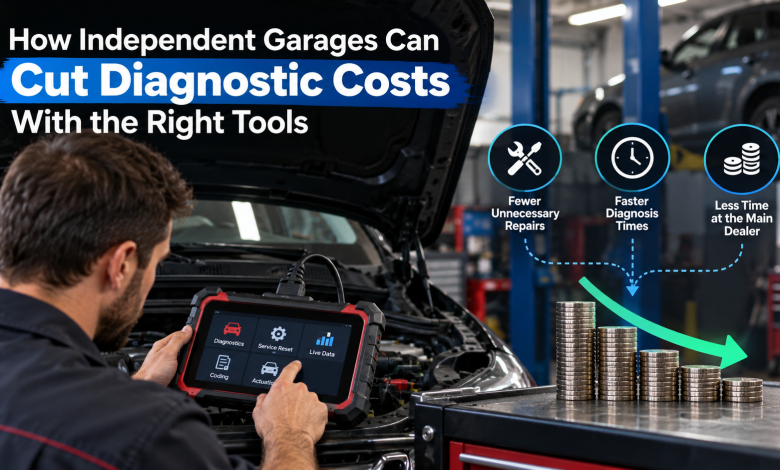
Ask most independent garage owners where their money goes and they’ll point to parts, wages, rent, the usual list. Diagnostic cost rarely makes that list, even though it’s often sitting quietly underneath several of those categories at once: in the hours a technician spends chasing a fault the tool on the bench can’t fully resolve, in the job that gets sublet to a specialist because the in-house kit stops short, and in the customer who takes their car elsewhere next time because the last visit took three days longer than it should have.
None of this tends to get tracked as its own cost, which is exactly the problem. It gets absorbed into “that was a tricky one” and forgotten, rather than added up across a month and treated as the recurring expense it actually is.
Where the Money Actually Leaks Out
None of this shows up as a single line item, which is exactly why it’s easy to underestimate. Broken down, it tends to come from a handful of specific places:
- Technician hours spent on trial-and-error diagnosis because the scanner can only confirm a fault exists, not what’s actually causing it
- Parts replaced on a reasonable guess that turn out not to have been the problem
- Jobs sent to a dealer or a specialist because the in-house tool can’t run a specific calibration or bi-directional test
- Customers who quietly stop coming back after a diagnosis took longer, or cost more, than it should have
Every one of these has a cost attached, and none of them show up as clearly as a parts invoice does. A wasted hour of technician time doesn’t get itemised anywhere. A part fitted on a hunch that didn’t fix the fault gets quietly written off as a mistake rather than logged as what it actually is, which is a diagnostic cost that happened to take the shape of a component.
The Real Price of Sending a Job Elsewhere
Subletting a diagnostic job out isn’t free, even when the invoice for it looks modest. UK garage labour typically runs somewhere around £60 an hour, and that’s before accounting for the time your own technician spends getting the car ready, liaising with whoever’s doing the actual diagnostic work, and picking the job back up once it returns. A fault that would have taken twenty minutes to properly diagnose in-house can easily cost an hour or more of combined time once it’s routed through a third party, on top of whatever that third party charges.
It adds up faster across a full week than most owners expect. Three or four jobs a month getting sublet purely because of a coverage gap, rather than genuine complexity, is a fairly ordinary pattern for a garage running an ageing or overly generic scanner, and it’s margin that’s gone before the customer even sees the final bill.
Put a rough number on it and the picture gets clearer. Four sublet jobs a month, each costing an extra hour of combined liaison and downtime at that £60 rate, comes to roughly £240 a month, or close to £2,900 a year, in time that’s effectively been given away rather than billed. That’s before counting whatever the specialist doing the actual work charges on top, and before counting the knock-on effect of a ramp sitting idle while a car waits to go out and come back.
What Changes Once the Right Tool Is Already on the Bench
This is the point where the maths actually flips. A capable multi-brand scanner that also handles the deeper functions, bi-directional tests, service resets, calibrations, means the job that used to leave the building now gets finished in it. iCarsoft diagnostic tools UK garages already use for everyday fault reading tend to close a decent chunk of that gap on their own, since the more capable models in the range go beyond basic code reading into the calibration and active-test territory that used to mean reaching for the phone instead of the tool bag.
The saving isn’t really about the price of the tool itself, which pays for itself reasonably quickly against even a handful of avoided sublets. It’s about what stops leaving the workshop. A job kept in-house is a job billed at your own labour rate, on your own timeline, with your own name on the finished work rather than someone else’s.
Take the air suspension fault that used to mean a call to a specialist because the old scanner could read the code but not run the calibration afterwards. With bi-directional access to the valve block and compressor built in, that same fault becomes a job your own technician finishes in an afternoon, billed in full rather than split with whoever used to get the calibration half of the work. A multi-brand model like the iCarsoft CR ULTRA P is built with exactly this kind of mixed-fleet bi-directional work in mind.
If you’re weighing this up against what you’re currently running, Albionshire stocks the full range of iCarsoft scanners to compare against.
Turning Diagnostic Time Into Billable Time
Speed matters here almost as much as capability. A tool that gets you to the right answer in fifteen minutes instead of an hour doesn’t just save that time, it frees up a ramp for the next job, which is where the real capacity gain shows up over a full week rather than a single afternoon.
There’s a customer-facing side to this too. A car that’s diagnosed and quoted the same day it comes in reads as competence to the person paying the bill, whatever the actual fault turns out to be. One that sits for two or three days while parts get ordered on a guess reads as the opposite, whether or not the eventual fix is correct, and that impression is exactly the sort of thing that decides whether someone calls you again next time or tries a competitor instead.
The same applies to the reviews that increasingly decide where new customers come from in the first place. “Diagnosed it properly first time” and “had it back the same day” are the kind of lines that show up in the reviews that actually bring work in, far more often than a low headline price does.
The Jobs You Didn’t Know You Were Turning Away
It’s worth being honest about the jobs that never make it onto the books at all. A customer who calls asking whether you can look at a fault on a brand you don’t normally see will often be told no before anyone’s actually checked whether the tool on the bench could have handled it. Widening what a garage can confidently take on isn’t just about reducing sublet costs on existing work; it’s about the jobs that currently go to a competitor by default, purely because nobody thought to check first.
This tends to matter most with the brands that show up occasionally rather than daily, a Land Rover here, a Mercedes there, in a workshop that mostly sees mainstream makes. Those calls get turned down almost on reflex, and the caller simply rings the next name on the list rather than waiting to be told no. A tool with genuine depth on those occasional brands turns a reflexive “sorry, we don’t really do those” into a booked job, without changing anything else about how the garage runs.
Doing the Sums Before You Buy
The honest way to judge whether an upgrade is worth it is to look back at the last few months of sublet jobs and turned-away enquiries, and add up roughly what they cost in lost time and lost work, rather than just eyeing the price tag on a new scanner:
- How many jobs went to a specialist or a dealer in the last three months purely because of a tool limitation, and roughly what did the combined liaison time and specialist’s fee come to?
- How many enquiries got turned down over the phone for a brand or fault type the current tool doesn’t handle well?
- What would need to happen to those two numbers for a new tool to have paid for itself within the first year?
For most independent garages doing even a moderate volume of diagnostic work, that answer arrives faster than expected, usually within a handful of months rather than years, and it’s that number that actually justifies the purchase, not the spec sheet on the box.